Get Familiar: Ezra Collective
Interview by Passion DEEZ
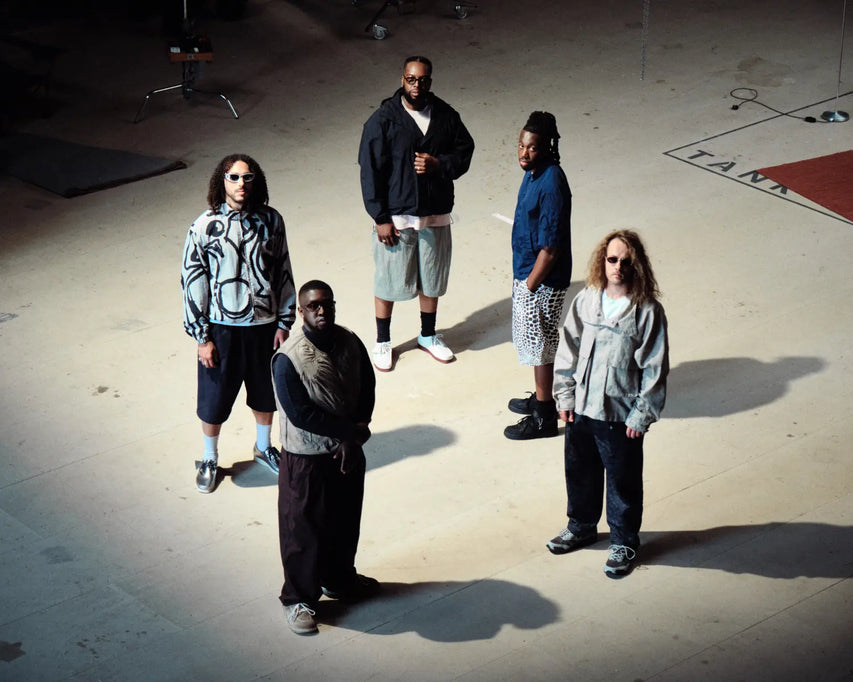
Ezra Collective’s new album, Here Because of Hope, feels like a record made by a band looking at where they have come from without losing sight of where they could still go. For bassist TJ Koleoso, that growth is less about becoming better musicians and more about developing the patience, perspective and understanding needed to make music about something as complicated as hope.
Having grown up playing alongside his brother and Ezra Collective bandmate Femi Koleoso, TJ has spent more than a decade developing the rhythmic relationship at the centre of the band. Along the way, Ezra Collective have gone from Tomorrow’s Warriors sessions to winning the Mercury Prize, being named BRIT Group of the Year and playing Wembley Arena, all while pushing jazz into spaces where it has historically struggled to receive the same mainstream recognition.
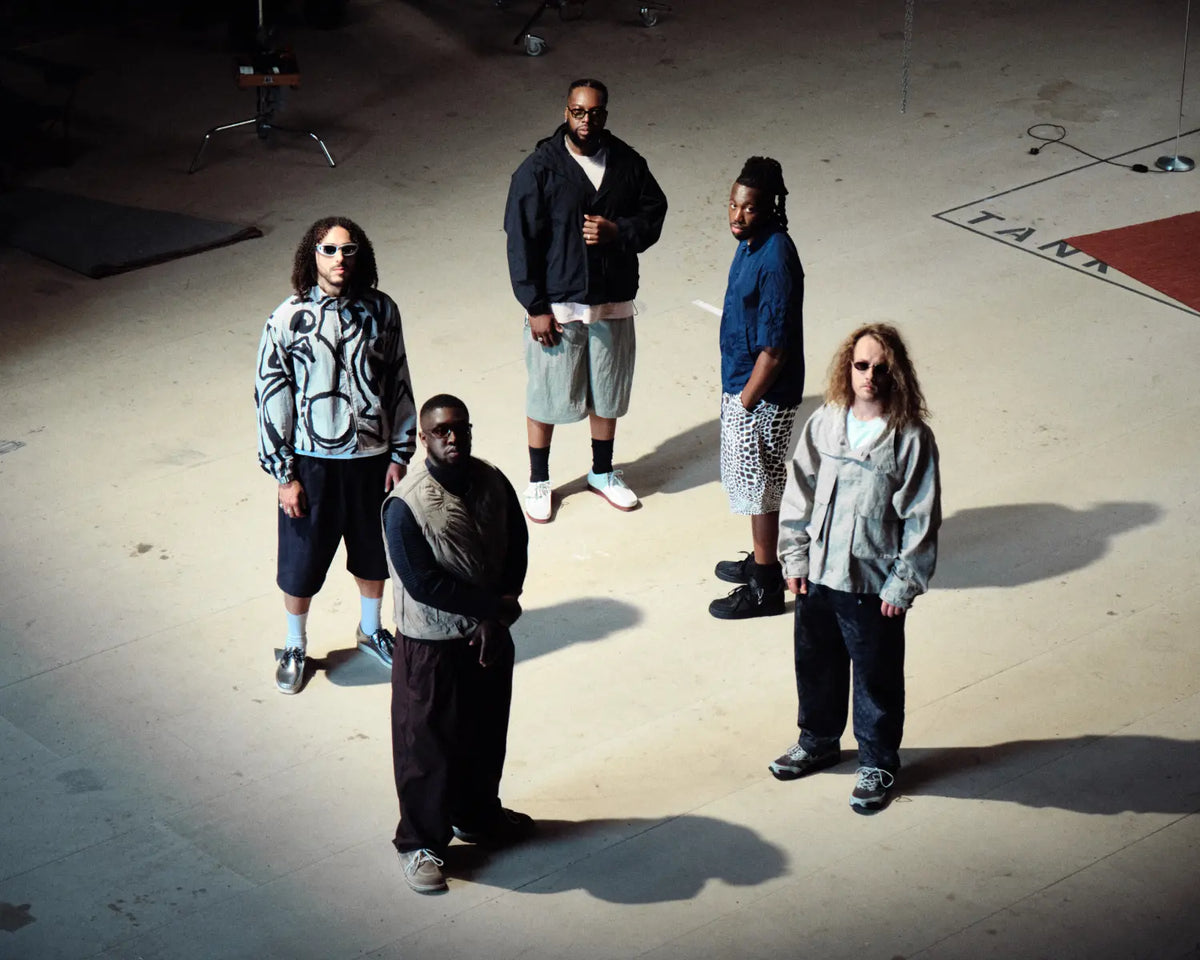
With Here Because of Hope, the ambition remains, but so does the humility. Speaking with Patta, TJ discusses learning when not to play, the bass as the glue holding Ezra Collective together, what Gary Crosby taught him about confidence without arrogance, the importance of developing away from the spotlight and why the band still wants to be the most ambitious people in every room they enter.

You’ve described Here Because of Hope as a record that reflects Ezra Collective growing up. What does that maturity actually sound like to you?
I’m not sure I necessarily meant that we’re going from being children to adults as if we’re better at playing now, or as if to say that we were childish in anything previously. I think the theme of hope is one that requires a more mature understanding of humanity and life.
The meaning behind a lot of the songs requires a slightly more mature outlook to really grasp what we’re trying to say. Musically, as we’re growing older, there’s maybe an increased patience with getting to a point of release. We’re waiting a little bit more and trusting the journey of certain songs, and more so the journey of the whole album.
Femi has spoken about studying West African and specifically Gambian music while making “Only Love”, and how that informed both the drums and bassline. As the actual bassist in the band, what happens when your drummer walks in with a bassline?
I don’t always write the basslines for Ezra songs. In fact, it’s probably rarer for me to write a bassline because we’re all songwriters. Everyone spends time writing their own music and brings it into Ezra.
At that point, it’s more a case of me putting my bassist hat on and approaching basslines that might have been written by somebody else, then adapting them in a way that I feel is going to sound like me and therefore sound like Ezra. We’re completely used to it. I never think, “Why have you written a bassline?” I love it when people come in with different ideas.
The magic comes when each of us takes responsibility for making those ideas sound like ourselves and, ultimately, making them sound like Ezra Collective.
You and Femi grew up together, played in church together and have now spent more than a decade in the same band. What can you do together rhythmically now that you couldn’t ten years ago?
Ten years ago, I was probably a lot worse at the bass guitar. Not even in a self-deprecating way; I just hadn’t played that much, relatively speaking. I’d played in school bands and was still trying to find my feet in the jazz world.
But the thing we prided ourselves on most was always being able to lock in rhythmically, especially on Afrobeat songs. That’s been really consistent over the last decade.
Now, there’s probably an increased amount of linking up that we do on certain songs, but there are also more surprises when we play together because we don’t live with each other anymore. We’re not kids anymore. Sometimes when Femi plays certain things, I’m forced to be a little bit more reactive than I might have been in the past, which is great. I love playing with him. I wouldn’t have it any other way.
There’s a lot of virtuosity in Ezra Collective, but the music rarely feels like five musicians trying to prove how good they are. As a bassist, how do you know when not to play?
I’ve had the benefit of never necessarily seeing myself as a virtuoso in any way, shape or form. I never studied jazz and always felt like I was maybe the least experienced person in the rooms I was in growing up. I just felt an immense sense of privilege to be playing with such talented musicians.
Especially having a brother like Femi, who has been playing drums since he was about three, while I didn’t start until I was 11, I was always in a position of humility. It was always: let me listen and play what is necessary.
I had a teacher at school who described the bass as the glue in the music because it has the ability to speak rhythm, melody and harmony. Our job is to translate for the rest of the players in the band and make sure everything sticks together and everyone understands.
If you take that job as a translator seriously, you don’t necessarily add too much of yourself. If somebody was translating my words and started adding their own opinions and bits and pieces, they wouldn’t be a very good translator.
That’s how I’ve always tried to approach bass. First and foremost: what does the song need to tie these different elements together? Sometimes that means doing something difficult or virtuosic, but more often than not it’s sitting down on the groove and providing a beautiful foundation for the more colourful melodic instruments to do their thing over the top.
The album asks why so much Black music created through difficult circumstances can contain so much joy. What’s your own answer to that?
The only way that’s possible is because of hope.
Our predecessors, our ancestors, those who came before us, our influences and inspirations, saw music as a tool for inspiring and invoking a fight in people — a fight for better tomorrows. That inherently is what hope is.
Music and writing were often, and still are, used as a means of resistance, survival, faith and community, but always in the direction of something better. When you make that decision to say, “I’m going to hope for a better tomorrow,” sometimes you have to sing it for your soul to believe it. And when your soul believes it, I think your actions are affected by that.
On “Only Love”, Pa Salieu is talking from a genuinely difficult period in his life while the band behind him sounds almost euphoric. How do you honour the pain in those words without simply turning it into celebration?
I think Pa did that himself. Hearing the music and what we were laying down and deciding to recount moments from his life is exactly what I was speaking about before.
If it was just poetry and you were listening to those words, it would be quite difficult to hear that somebody’s life had been like that. But then you think about the tension built up during the verses and what the release is. The release in the chorus is him saying, “Only love is what I have deep inside my soul.”
That becomes an anthem of resistance and perseverance. You’re not dwelling or sticking in a bad situation. There’s that release of: this is how I kept fighting, this is how I continue, this is why I’m dancing right now.
He’s such a musical rapper that he got that straight away. The theme of the lyrics fits the music absolutely perfectly.
You came through Tomorrow’s Warriors, which was co-founded by Gary Crosby, himself a bassist. What did seeing a bass player become a mentor and community-builder teach you about what your own role could be?
Gary is a special, special man, mentor and inspiration. His superpower is that he can make you feel like you can do anything.
If you play one bass note but play it with your whole soul, he’ll stop the whole class and say, “Well done.” Or you’ll be playing and feeling like things are difficult, and he’ll identify you in the class, walk over and whisper in your ear, “Man, keep going. You’re sounding great. Just dig in a little bit more.”
Those moments are invaluable because they make you feel like you can do anything.
I take the lessons I learned from him onto the stage every single time we step out there. It’s not about how much you’re getting rated by everybody else. It’s about the feeling you have deep in your soul and the conviction you have when you’re playing the music. That’s what carries out to the people listening.
Even if you hit a couple of duff notes, you can hit them properly, if that makes sense.
I hope I’m honouring Gary with how I approach bass, not just in what I’m playing, but in trying to have confidence without arrogance. That’s something he definitely taught us.
Tomorrow’s Warriors gave you somewhere to develop before there was any guarantee Ezra Collective would become successful. Now that you’ve played Wembley Arena, won the Mercury Prize and won BRIT Group of the Year, what responsibility do successful musicians have to protect those spaces?
Tomorrow’s Warriors was a place of inspiration, education and beautiful obscurity, which is needed.
We’ve all got examples of child stars who attain fame at such a young age, and we know how that story can go. There’s such an importance in developing in obscurity. There’s a massive place for organisations like Tomorrow’s Warriors where you can hone your craft, but also develop an approach to music that is well-rounded, holistic, always listening, meek, confident and yet not egotistical.
It’s our responsibility as people who are maybe a little bit ahead of those 10 or 15 years younger than us to pass on these lessons, teach one another and create spaces where people can grow and develop in obscurity.
Someone once told me it’s like taking photographs on a film camera. They have to be developed in a darkroom. If you expose them to the light too quickly, you can lose what could have been something beautiful.
I try to hold onto that. Success or the spotlight may happen afterwards, or it may not. But at the very least, young people can have a level of grounding and know that their value isn’t built on success as deemed by other people. It’s about success as deemed by their integrity and the effort they’ve put into what they’re doing.
The five of you increasingly have substantial musical lives outside Ezra. What does the word “Collective” mean now compared with when you started the band as teenagers?
I’m super happy everyone’s doing their thing. We’re creatives and artists at the end of the day, so there’s spillover and there are projects people want to pursue.
I don’t think the word “Collective” means anything different today than it did when we started the band. We are individuals who come together to do something with a common goal and agenda. That’s what a collective really is. It’s the identification of individuals without the veneration of one individual over the others.
When we play shows, it feels like we’re making the crowd part of the collective. Our crew, staff and management all know they’re part of the collective as well. There’s this holistic way of looking at the music where we’re all trying to achieve one goal together.
It speaks to the five of us as a band, then the whole crew, and then the crowds who come and watch and listen as well.
Which bassline on Here Because of Hope are you most proud of — not necessarily because it’s technically difficult, but because it does exactly what the song needs?
I don’t know if “proud” is the word, but I do like “Black Flag”. It’s one that I wrote, and I like the way it came about because I’d spent all day working on another song that wasn’t quite happening. Then, in about three minutes, I wrote “Black Flag”, played it to the guys and they were all like, “Yeah, that’s it.”
Sometimes it’s a good reminder that there isn’t an equal ratio between how much time you spend on something and whether it’s going to work.
If we’re looking at UK broken beat and a bit of what UK jazz sounded like early on, I think that song really nails it. We’ve had that kind of sound throughout quite a lot of our albums, so it’s nice to have that on this one.
It is quite difficult to play as well. It kind of burns your hands if it goes on for too long. But yeah, I love that one.
If the last ten years were about proving Ezra Collective could take this music into spaces people didn’t necessarily associate with jazz, what do you want the next ten years to prove?
Our job is to stay the most ambitious people in the room every time. That’s something me and Femi have spoken about in random chats. We just need to stay the most ambitious people.
Whatever that looks like in the next ten years remains to be seen. But if we end up playing a stadium tour, we can’t be surprised by it. Everyone else can be surprised, but we can’t. It was the same with Wembley or whatever accolades have come our way. They’re things we’d spoken about before and said, “You know what? I reckon we could do that. I reckon we could get there.”
I see Ezra as having a bit of a mandate to keep going. Whenever somebody says, “the first jazz band to do something,” I’m like, that’s cool, but it’s also not cool because jazz has been around for a really long time. It shouldn’t have taken 100 years for certain things to happen.
As long as there are still things to be done first, I see Ezra as having a mandate to knock on that door and see if it opens. The main thing is doing that without losing who we are. Can we be ourselves, play the music we love, not compromise on who we are and still pioneer certain things?
The reason we want to do that isn’t for ourselves. When something gets done once, it becomes attainable and realistic for everybody coming after.
There are so many bands coming out of the UK from a jazz background, and I’m looking forward to seeing how many of them become staples in UK music and are appreciated by people who, deep down, would probably love the music if they just knew about it.
So yeah, onwards and upwards, by the grace of God.
 For Ezra Collective, ambition has never seemed to be about collecting milestones for their own sake. The Wembley shows, awards and “firsts” matter because each one makes the next possibility feel a little less distant for the musicians coming behind them. Here Because of Hope captures that same outlook: understanding where you come from, believing something better is possible and doing the work required to get there. More than a decade into their journey, Ezra Collective are still looking for the next door to knock on — only now, they know that when it opens, they are not walking through it alone.