Get Familiar: Charity Charly
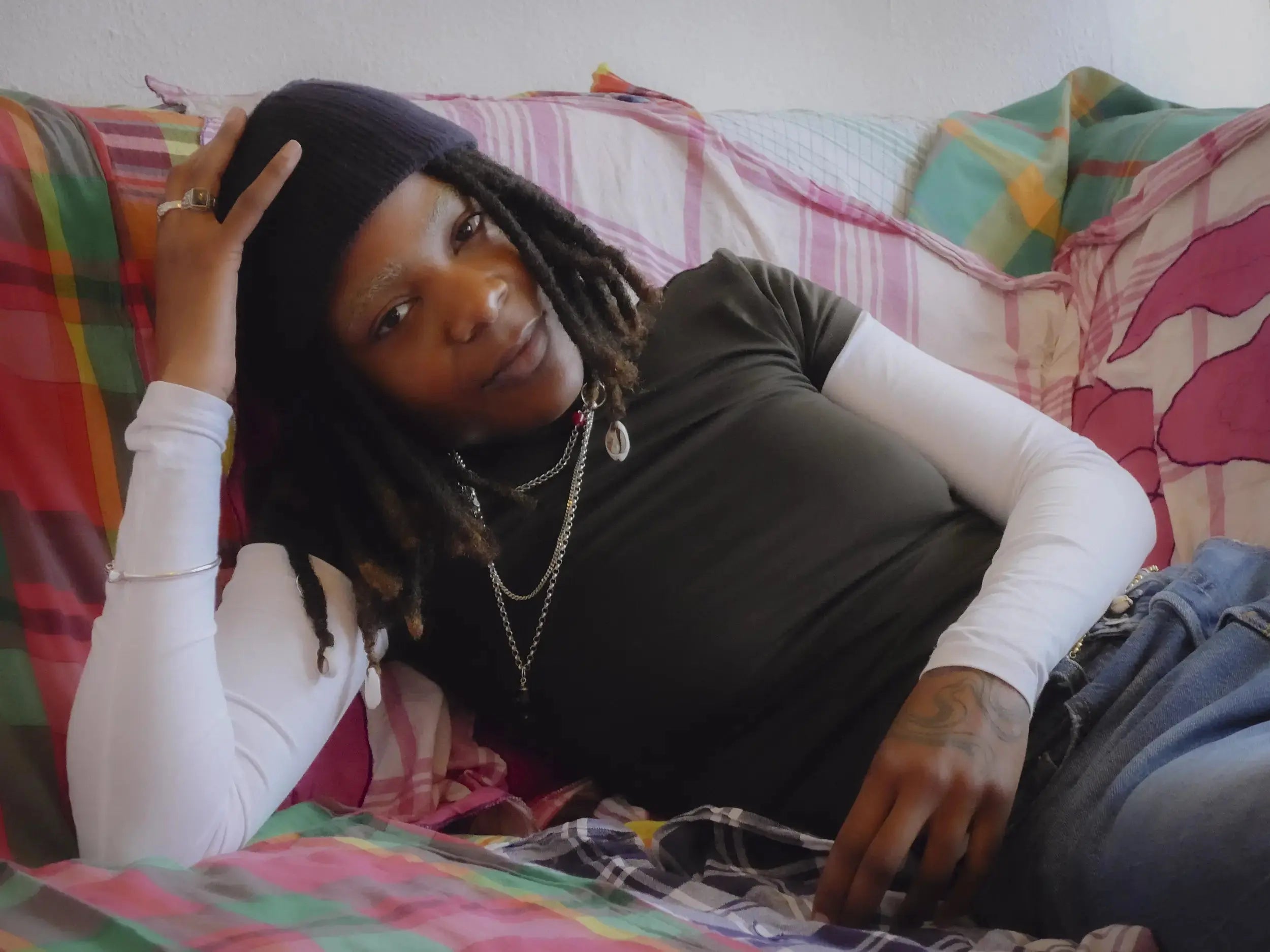
Interview by Liesje Verhave | Photography by Brunei Deneumostier
In her directorial debut, Tra Fasi (2026), filmmaker Charity Charly steps into Suriname’s underground punk scene through the story of Shavero Ferrier. Shavero, a young cultural organiser, creates space for punk parties and self-expression in a society that often leans toward conformity. Charly, with a multidisciplinary background in film from camerawork and styling to set design, brings a personal and multifocal lens to her work.
Driven by a desire to reveal overlooked experiences and challenge dominant narratives. We spoke with her about her first steps into filmmaking, the making of Tra Fasi, and her vision for the visual stories still to be told.
You’re quite a multidisciplinary creative. How did your journey from camerawoman to director, and this “jack-of-all-trades” path, begin?
My journey started as a videographer. I worked at BNNVARA, where I was directing, editing, and doing camera work all at once for their YouTube platform. I always felt that I was good at what I was doing, but something felt a bit off. I just wanted to direct. I had so many stories in my head, and I just wanted to focus on directing only. So that is where my dream of becoming a director started.
To make a film, I knew I needed experience on set, so I started as a production coordinator. Then I moved into costume styling, and after that into set dressing. After doing all of that, I finally had the courage to direct my own film. Tra Fasi is really the start of my directing journey, although I’ve been working in film for about four years now.
So you tried out every possible role in the film industry first before directing?
Exactly. But I always felt the urge to direct. Even when I was on set watching directors, I would think, “I would do this differently, or I would do that.” That feeling was always there.
Do you think working in all those roles informs how you direct now?
Yeah, definitely. All the departments I’ve worked in have helped me develop a clearer vision of what I want to see on screen.
What first drew you to visual storytelling like film and visual art?
I was always obsessed with films. I could watch the same movie eight times in a row and memorize the whole script. I would perform it and make my brother play the other roles with me.
I also used to ask my mom to sign me up as an extra in films. But when I was on set, I wasn’t focused on being an extra; I was watching the crew. I was always distracted by how everything worked behind the scenes. Somehow, I always knew I wanted to make films. Even as a kid, I used to say my name would be in the credits one day.
Are there any films you remember from that time?
Yeah, Like Mike with Lil’ Bow Wow. That was one of my favorites. I knew it by heart and used to act it out with my brother while playing basketball.

You’re largely self-taught. What challenges came with that?
I used to study media studies, but didn’t finish. I ended up going to university for media and culture, but left after seven months. I was bored. I thought, “Do I really need to know this to work on sets?” So I was like, let me find out how I can do this on my own.
The biggest challenge was insecurity. You hear a lot about people who went to film school and, after that, their careers just get a major boost. I struggled with representation. Not seeing people who look like me doing this work, there were times I felt like I didn’t belong.
I remember wanting to become an actress and getting through the first round of auditions, but I got so insecure that I didn’t go to the second round. I started doubting whether there would even be roles for someone like me.
But once I knew I wanted to direct, things started falling into place. I was very open about what I wanted to do, wrote scripts, and connected with people. I was really curious, and at some point, I just stopped letting rejection discourage me. Even though I heard a lot of no, I kept going. For me, this was a big milestone because this is what I wanted to do.
Are there other art forms you still want to explore?
Definitely, it’s actually funny because I never thought I’d make a documentary; it just happened. I’m still very obsessed with fictional stories and the way you can portray them. I would love to explore that more.
I also acted on screen for the first time last year and really liked it, so I want to develop that further. And I make resin art, I love working with my hands. That’s something I’ll keep developing as well.
Is the resin work more of a hobby or something you want to build professionally?
It started as a hobby. Also, funny story, I made ashtrays and posted them on Instagram, and people wanted to buy them even though I wasn’t selling them yet. That made me realize I could turn it into something more. Now I make custom pieces for customers.
How did the story of Tra Fasi come together? How did you meet Shavero?
It started with the idea of making a documentary about Black punkers in the Netherlands. But I found that there were already projects about that.
Then I realized I was going to Suriname soon and got curious about punk there. I started researching and discovered it actually existed. I found an article about Shavero and his band Mutha Flac, and something about him really stood out to me.
I started following him on Instagram and noticed this whole alternative scene. I was like, “How did I not know this existed? I go to Suriname every year and never see this.”
I messaged him, and he responded quickly. We had a call, and at first I planned to make a documentary about multiple bands, but none of them interested me as much as Shavero. So I told him I wanted to focus on him, and he said, “That’s dope, I’ll organize an event when you’re here.” So I was like, “Okay, let’s go. I’ll capture that.”
That’s how it started. Once I got to Suriname, everything shifted. I had a plan, but after the first day, I realized I had to let go of it. The environment, the heat, not being able to film before 3 or 4 - it all required a different approach. I just went with the flow.

What stood out to you about that scene?
The energy. Because events aren’t as frequent there, people really go all out. The love and intensity are on another level. It’s a completely different energy.
You also brought Shavero to the Netherlands. How was that experience?
It wasn’t even the plan at first to do a tour here. My DOP Nadine Haselier and I just wanted to bring him here so he could connect with people. He does so much for the community, so we just wanted to do something for him. We started crowdfunding, and it gained so much attention that venues wanted him to perform.
Seeing him perform here was emotional. The Garage Noord concert was crazy. I crowd surfed for the first time in my life. Watching his dream come true and seeing how people responded to him and his sound, it was special. It felt like two worlds colliding.
The film centers on self-expression in a conformist society. How did you approach that visually?
I didn’t overthink it. I used strong visuals of Suriname and contrasted that with Shavero’s self-expression. The editing style is very DIY. The whole film just screams self-expression.
Did anything about the experience in Suriname change you?
Completely. It changed how I see Suriname. I didn’t expect that scene to be there, and I felt both surprised and a bit guilty for thinking it didn’t exist there.
Seeing people who look like me and share the same mindset, the same attitude in life, was such a beautiful enlightenment. But at the same time, I realized how much harder it is to express yourself there compared to here. I will still get that job even though I dye my eyebrows blonde; there, you have to be ten times bolder to be yourself.
That experience really shifted my perspective and deepened my connection to my motherland.
You’re working on a new project now. How are you approaching it differently?
With every project, you learn and want to do things differently. I always try to give something nostalgic and to surprise people, to make people think differently about stereotypes and question themselves. I’m currently working on a new film about the gabber/hardcore scene in the Netherlands, focusing on black youth within that scene.
It’s a similar niche approach, highlighting something we haven’t really seen.
What drew you to that scene?
I don’t even listen to hardcore, and that’s what makes it interesting to me. I’m curious about what draws people to that scene. Hardcore never dies!
I started researching and found a whole bunch of young black kids going hard to this music. Even though I don’t like the music, seeing them loving it so much fascinates me. I’m going to a hardcore party soon to experience it firsthand.
What perspective do you want to bring to that story?
I want to show it from the perspective of people of color, especially women. Most of what we’ve seen before is from a very white, male perspective. I want to do the complete opposite.
For me, the reason to make something is simple: if we haven’t seen it yet, that’s exactly why it needs to be made.
What can people expect from the upcoming Tra Fasi screenings?
A good film and a new, refreshing perspective on Suriname! At the Melkweg, I’ll also be doing a Q&A, chit-chat about the movie and the process. I’m really excited to talk to people also afterwards.
Upcoming Screenings:
4/04 Melkweg
24/04 Paard Den Haag
10/05 Humans of Film Festival
22/05 Plantage Dok Amsterdam
5/07 Down The Rabbit Hole